FITTING OUT
APPUSKIDU
Boarding Step
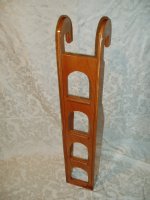
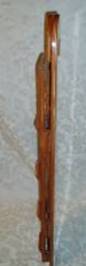
It became clear
when I got the Coaster that I could not easily get back on board if I went for
a swim. I could only just get back on the Lugger by standing on the cavitation
plate of the outboard but this didn’t work on Appuskidu. Either the geometry of
the Coaster stern is just that bit different or advancing years were taking
their toll – probably a bit of each. Anyhow, something had to be done since if
I went over the side either involuntarily or voluntarily I needed a way of
getting back.
I eliminated
purely rope based solutions. If the step was low enough to be useful to a
person of my size and limited agility, it would disappear under the boat as
soon as I put any weight on it. This meant that a rigid boarding ladder was
needed.
Any boarding
steps had to stow neatly on deck and be reachable from outside the boat. The
best stowage place seemed to be against the inside of the bulwarks on the
starboard side at the stern – between the main sheet horse and the transom. A
prototype was thus made from 11mm ply which would fold flat and fit in the
available space. It worked well but I thought that it might be better just a
little longer so I added a small rope bridle to give a step which a couple of
inches lower still. I could have made the ladder longer in the first place
since there were a couple of inches of space left on deck if I used up every
millimetre available. I later had my drawings converted to Autocad and some
sets of parts CNC routed to make up a few kits for friends. These used the full
available length.
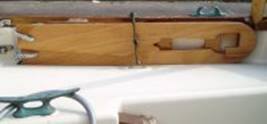 The hinges on one side are raised on
11mm blocks so that one side will fold over the other and the ladder folds flat
against the bulwark. The height of the bulwark dictates that the ladder be wide
enough for only one foot and not two side by side. In fact in order to
re-board, not only is a step for a single foot sufficient but if it is in the
right place only a single step for that foot is needed. This boarding aid has
multiple steps and to use it you put your foot in the highest step that you can
manage. The chrome plated brass hinges on the prototype need to be lubricated
once each season to stop salt crystals seizing them. However, the final hinge
solution uses sturdy pressed, 316 stainless steel backflap hinges with a bigger
pin clearance so they should always remain free to open.
The hinges on one side are raised on
11mm blocks so that one side will fold over the other and the ladder folds flat
against the bulwark. The height of the bulwark dictates that the ladder be wide
enough for only one foot and not two side by side. In fact in order to
re-board, not only is a step for a single foot sufficient but if it is in the
right place only a single step for that foot is needed. This boarding aid has
multiple steps and to use it you put your foot in the highest step that you can
manage. The chrome plated brass hinges on the prototype need to be lubricated
once each season to stop salt crystals seizing them. However, the final hinge
solution uses sturdy pressed, 316 stainless steel backflap hinges with a bigger
pin clearance so they should always remain free to open.
On my boat the
steps are held in place by shock cord which loops over a lacing hook under the
outside of the gunwale. Any catch reachable from outside the boat would do. In
use it is released and then the ladder is hooked over the gunwale amidships
where your own weight holds it in place long enough to board and recover it.
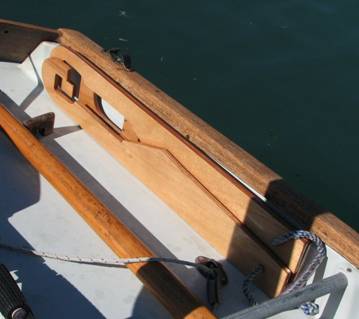 Here is a picture to prove that the
steps stow just as easily on a Lugger. The optimum place to hook them over the
gunwale when using them on a Lugger seems to be about half a metre aft of the
Jib sheet fairleads and jammers.
Here is a picture to prove that the
steps stow just as easily on a Lugger. The optimum place to hook them over the
gunwale when using them on a Lugger seems to be about half a metre aft of the
Jib sheet fairleads and jammers.
The starboard
side is a less cluttered stowage location. Here they are shown on the port side
because that is where the sun was shining when I took the photograph.
I have used my
boarding step for several years and it has supported my not inconsiderable
100Kg. You will discover that quite a lot of effort is still required to get
aboard even when wearing just a swimming costume. If you make a similar
boarding step you must test it in a situation where you have alternative
means of getting out of the water before you rely upon it.
Now look at
the “Boarding step extension” page.