Fitting out Drifter 22
'Appuski Too'
Solutions for lifting the motor
Starting with my Mizzen Derrick.
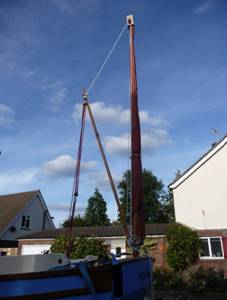
This
is a project that I have dreamed about for years but seems a natural for the
D22. It came to the top of the jobs list as the Drifter 22 is higher from the
ground than the Coaster or indeed the Lugger and the passing years are sapping my
strength and I now need help to remove
even my small 6hp outboard motor. The answer, I decided, was a Derrick. The
mizzen mast looked to me to be up to the task, I just needed a
some extra blocks at the masthead and a yard to bring the lifting point
above the engine. Now that I have a boom I could have tried using that, but the
mizzen derrick has the advantage that everything is to hand in a compact area
at the stern for easy single handed control.
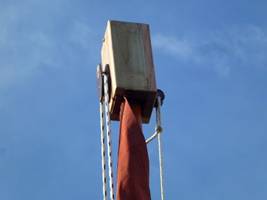
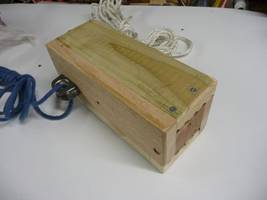
I
didn't want my masthead cluttered with extra blocks and in any case it is a bit
small at the top to be taking meaty block fixings so I made up a cap about a
foot long that I could slip over the top of the mizzen mast for the one
occasion each year when I need to lift the motor in and the one when I need to
lift the motor out. As it would not normally be on view it didn't need to look
pretty so the cap was made from four scrap pieces of decking cut down for a
snug fit and lined with soft old shoe leather to protect the sail. The parts
are screwed and glued together with a small leather
lined square in the top which is bolted through for extra strength. On one side
of the cap I screwed a spare bullseye fairlead for
the throat halliard. I say halliard but the throat one is just a fixed length
rope. On the opposite side, to serve as the block for the peak halliard I fixed
an old centre plate uphaul block from my Lugger which was broken but had one
good sheave.
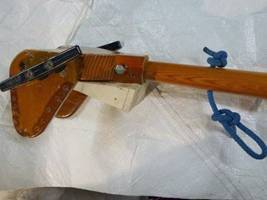
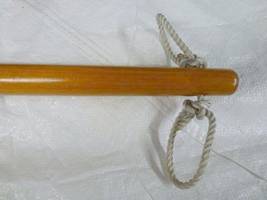
The
yard comprises the second of the two dinghy spars which my neighbour left me
when he moved. (The first is now part of the mast lifter). The wooden jaws of
the yard are from an old mark one Lugger yard (which I had broken by setting a
jib topsail flying from the top of the yard to the end of the bowsprit - where
a jib was also tacked down in front of the original staysail.) These old jaws
also served at the top of the Coaster's mast crutch until I made the telescopic
crutch. The yard is longer than it needs to be to put the lifting tackle over
the engine but the extra length reduces the angle between the yard and the
mast, hopefully reducing the bending moment on the mast. Someone who is better
at geometry than I am can tell me if the length of the yard actually makes any
difference. A couple of cleats (ex Coaster lazarette hatch tie down cleats) are
fitted to the jaws. These serve for the end of the peak halliard and the
hauling end of the lifting tackle. A simple cord where the parrels would
normally go secures the jaws to the mast. Tied below the boom gooseneck this
cord also prevents the jaws from riding up. The blue loop in the picture is for
the throat halliard. The light coloured wedges in the picture are probably
redundant. The loops at the top of the yard are for the peak halliard on the
top side and the lifting tackle on the underside.
Any
suitable tackle of the necessary power will serve for the lifting tackle which
dangles from the end of the yard. I am fortunate in that many, many years ago I
bought a long length of cheap red MOD surplus rope which had been used for
towing targets behind aircraft. As a free bonus this came with two ugly
aluminium double blocks which have finally found a use since they are ideal for
my lifting tackle.
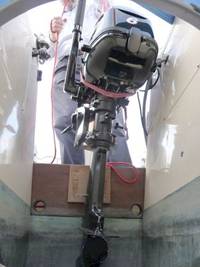
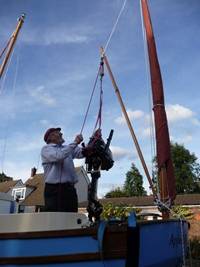
To
lift out the engine I fit the cap to the mizzen mast, rig the halliards, step
the mast, rig the yard and lifting tackle, fit a secure strap to the engine,
loosen its mounting clamps, hoist away and swing the engine over the side. All
this can be done single handed. However, the cleats on the jaws cannot be
reached from the ground so a second person is useful to guide the engine onto
the engine stand. However, this person does not need to take any of the weight
of the engine. In the absence of a second person the operation could be done
single handed using a large piece of carpet hung over the side of the boat so
that the engine can lean, suspended alongside, whilst you make off the hauling
end of the tackle and go down a ladder to manually locate the engine the last
few inches onto its stand/trolley. Lifting the engine into the boat from the
trolley can be a single person operation as it can all be controlled from the
cockpit. The pictures show the derrick in use for the first time where, as you
see, things are a bit untidy.
By
the way, my stand has now become a trolley - see folding engine
stand for details.
Sling
You
will of course need a sling around the engine to connect the lifting tackle to.
I have made my own from 25mm webbing much like the ones that are available
commercially. Jol Wardle has pointed out the DIY rope
sling instructions which can be found at
Easylink
Marine - DIY harness plans
Alternative solutions
In
the Facebook 'Drascombe' group as I was preparing
these pages Jol Wardle and John Christie posted the
solutions mentioned below.
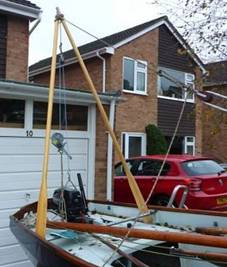
John's 'Oarlegs'
John
Christie uses his oars as sheerlegs to lift the motor
from his much travelled Lugger. One of his pictures is reproduced here (with
permission). In this set up he uses a winch for the lifting tackle but any
tackle of adequate power and length will suffice to lift the engine above the
boat. Then, using the second tackle which goes from the front of the boat to
the top of the rig, the legs are tilted backward and down thus lowering the
engine beyond the boat where it can be let down to the ground.
Jol's Boom Crane
To get a heavy motor onto his Longboat Cruiser Jol Wardle used a boom crane solution. Details can be found at http://soul-trade.com/sailing/boomhoist/ and were published in the 2014 Winter DAN.
Warnings
If
something breaks it could get expensive so you are reminded that you try these
projects at your own risk. If you decide to try the mizzen derrick on your D22,
first check that your mizzen step fixings are in good shape. Note that my D22
mizzen mast bends slightly with the load so when the engine is swung outboard,
keep it close to the boat and don't try to lower the derrick yard more than is
necessary. If you try it with a heavier motor or on a Lugger or Coaster don't
blame me if something breaks - but do let me know how you got on. If you try it
on a Lugger or Coaster beware the hole in the outboard well that the heel of
the mizzen steps into. On older boats this may well have warn thin. In any case
this area of GRP is unsupported and it would be better to find a way of
spreading the load unless you can get underneath it on your boat to prop it up
from below. Possibly a short plank across the bottom of the outboard well with
three bits of 2" x 1" screwed on to make a box structure to constrain
the foot of the mast and perhaps a block screwed underneath to fit in the GRP
hole (without reaching the bottom) to prevent the plank moving aft. As the mast
is tapered and will then be higher by the depth of the hole plus the thickness
of your plank, you will need something to pack the hole in the rudder capping
for a tight fit around the mast. For a Lugger/Longboat or Coaster, Sheerlegs may be a safer solution. If you have a Longboat
Cruiser with a boom then using the boom may be a safer option. Hopefully
someone may enlighten me as to whether a boom equipped original Drifter would
have a long enough boom to reach over the motor.